UPVAN JAWAI
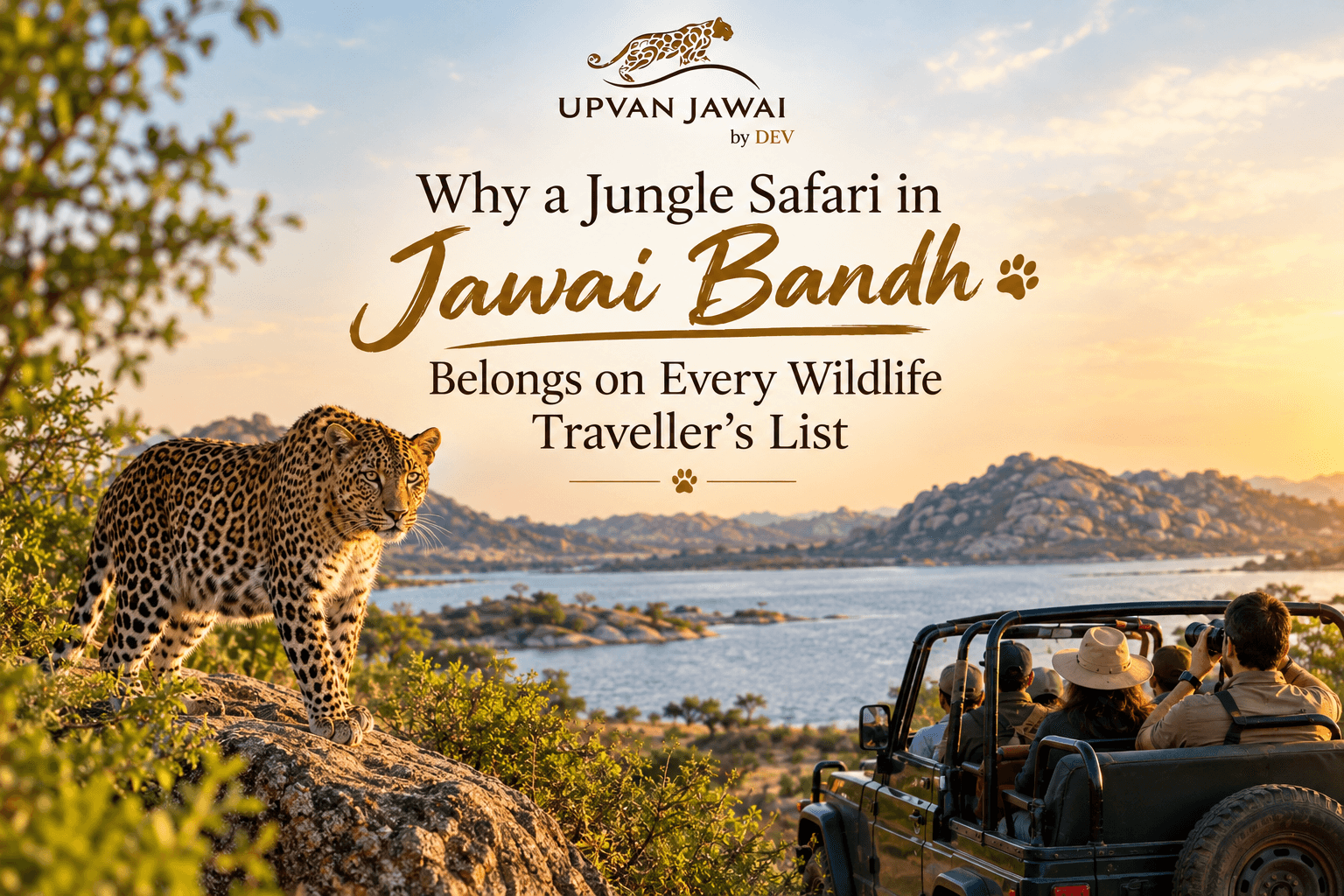
Jungle safari in Jawai Bandh: leopards, granite hills & open-jeep drives with Upvan Jawai.
Most people planning a wildlife trip to India default to the familiar names — Ranthambore, Bandhavgarh, Kanha. Fewer know that a few hours from Udaipur and Jodhpur, in a landscape that looks nothing like a conventional forest, sits one of the densest leopard populations anywhere in the country. A jungle safari in Jawai Bandh isn't a smaller, quieter version of those parks. It's a genuinely different kind of safari, built around terrain, community, and animal behaviour that don't exist together anywhere else in India.
This is a closer look at what sets it apart, and why it's worth building into your Rajasthan itinerary.
A Safari Without a Park
The first thing to understand about a jungle safari in Jawai Bandh is that there is, technically, no jungle in the traditional sense — and no park gate either.
The landscape around Jawai Dam in Pali district is made of granite: enormous rounded boulders piled into hills, riddled with caves and ledges, scattered across farmland and open scrub. The formally notified Jawai Bandh Leopard Conservation Reserve covers just 19.79 sq km, but the leopards themselves range far beyond that boundary, across land that belongs to villages, not the Forest Department. Most safari routes operate on this community land, which is why access here doesn't run through the permit system that governs India's national parks.
Practically, that means no quota battles, no fixed circuit, and no months-long closure during monsoon. A safari here runs on the naturalist's read of the terrain that morning, not a predetermined loop.
The Leopards That Live in Daylight
Leopards have a reputation, earned honestly in most of India, as the hardest of the big cats to actually see — nocturnal, solitary, expert at staying hidden in dense cover. Jawai inverts that reputation almost entirely.
Because the terrain is open granite rather than forest, leopards here have nowhere dense to disappear into. Instead, they rest in caves and on exposed rock ledges — frequently in full daylight, frequently visible from a considerable distance. It's not unusual for a naturalist to point out a leopard curled on a sunlit boulder from two or three hundred metres away, something that would be close to impossible in denser terrain.
This is also one of the highest leopard densities recorded anywhere in India, concentrated in a relatively compact area around the reservoir. The two factors together — high density and unusually open terrain — are what make sightings here meaningfully more consistent than in most other parts of the country, even though nothing is ever guaranteed with wild animals.
Reading the Hills Like a Local
What makes a Jawai safari work isn't luck; it's a completely different tracking method than the one used in forested parks elsewhere.
In dense forest, trackers read pug marks in soft ground. On granite, there's almost nothing to read that way — the rock doesn't hold a print. So naturalists here have developed an entirely different skill set, built on things that have nothing to do with the ground at all:
- Alarm calls from peafowl and langur, which usually give away a leopard's position before it's ever seen directly
- Knowledge of individual leopards' territories — which slope a particular male has been crossing at dusk this week, which cave a female with cubs is currently using
- Reading the movement of grazing livestock — watching where the local Rabari community's sheep and goats are heading, and just as importantly, where they're refusing to go
This is knowledge built from years spent in these specific hills, not a transferable skill from another park. It's also the reason local, community-based naturalists tend to outperform generic safari guides here — this isn't a landscape you can learn from a guidebook.
The Dam Behind the Density
None of Jawai's wildlife exists in isolation from the reservoir that gives the place its name. Jawai Dam was built across the Jawai River in 1956–57, and it remains the largest reservoir in western Rajasthan — a structure built for irrigation and drinking water that, decades later, has quietly become the backbone of an entire ecosystem.
The water sustains prey populations through Rajasthan's long dry season, which in turn supports the leopard density that draws visitors here. But the reservoir's role goes well beyond the cats. Its shallows attract more than 200 recorded bird species, including greater flamingos and bar-headed geese arriving from thousands of kilometres away. Mugger crocodiles are permanent residents in the water itself. And the granite caves rising directly above the waterline give leopards secure, shaded daybeds within easy sight of the villages that border the reservoir.
A jungle safari in Jawai Bandh, in other words, is really a safari built around one dam's fifty-year-old ripple effect on an entire landscape.
Coexistence, Not Conservation-by-Fence
Perhaps the most distinctive thing about Jawai has nothing to do with the leopards directly — it's the human relationship with them.
The Rabari, a pastoral herding community, have grazed sheep and goats across these same hills for generations, living alongside one of India's densest wild leopard populations without fences and, notably, without a tradition of retaliatory killing when livestock is lost. Elsewhere in India, human-leopard conflict is a serious and ongoing problem. In Jawai, it largely isn't — not because the leopards behave differently, but because the community's relationship with them is different.
This matters for anyone taking a safari here, beyond being an interesting fact. It means every sighting depends on an arrangement that long predates tourism, and it shapes how a responsible safari should be run: routes stay guide-led, engines go off and voices go down at a sighting, and no jeep pushes for a closer view than a leopard is willing to give. Good field conduct here is really an extension of the same respect that's kept this coexistence intact for generations.
What a Drive Actually Feels Like
Anyone who has done a safari in a conventional park and expects the same pacing in Jawai should recalibrate first.
Drives leave early — well before sunrise for the morning slot — and the first stretch in an open jeep is genuinely cold through the winter months, cold enough that a proper jacket isn't optional. The jeep climbs steadily into boulder country as the light comes up, weaving between granite formations that look almost sculptural at that hour.
Then, more often than expected, everything simply stops. Engine off. The naturalist listens. This is not downtime — it's the actual method, and it can last considerably longer than a first-timer expects. What follows the wait, when it pays off, tends to be worth the patience: a shape on a distant rock slowly resolving into a leopard, sometimes with cubs, sometimes simply stretched out watching the valley below.
Guests who come in expecting a Ranthambore-style, constantly-moving circuit often find the stillness strange for the first hour. Almost everyone who's done it says afterward that the waiting is what they remember most clearly.
Building a Jawai Safari Into Your Trip
A single drive gives you a single chance, and on wild, unfenced terrain, that's genuinely a gamble. The stronger approach — and the one most experienced naturalists here will recommend — is treating Jawai as a two-night stay with at least three drives built in: morning and evening on the first full day, plus one more slot. That structure gives the hills enough chances to produce a sighting without leaving it to a single roll of the dice.
October through March is the easiest season for most travellers — mild days, cold clear dawns, and the reservoir full of migratory birds. But because Jawai has no seasonal closure, it's also one of the few genuine year-round wildlife destinations in Rajasthan, with April to June offering a different, more intense kind of viewing as shrinking water sources concentrate wildlife around what remains.
A Different Kind of Wildlife Encounter
What ultimately distinguishes a jungle safari in Jawai Bandh isn't just the leopards, though they're the obvious draw. It's the combination of things that don't usually coexist: exceptional big-cat density with almost no barrier between wildlife and people, a landscape built more by a dam's engineering than by any deliberate conservation boundary, and a local community whose long-standing tolerance is the quiet condition that makes all of it possible.
For travellers who've done the more established parks and want something that doesn't feel like a repeat of the same format, Jawai offers a genuinely different rhythm — less circuit, more patient attention, and a landscape unlike anywhere else leopards are found in India.
To plan a stay and safari drives with Upvan Jawai, reach out via WhatsApp at +91 90798 46869 or send your travel dates through the enquiry form. Jeep availability is limited, and the October–March season tends to book out well in advance.
Written by Upvan Jawai
Plan your stay