UPVAN JAWAI
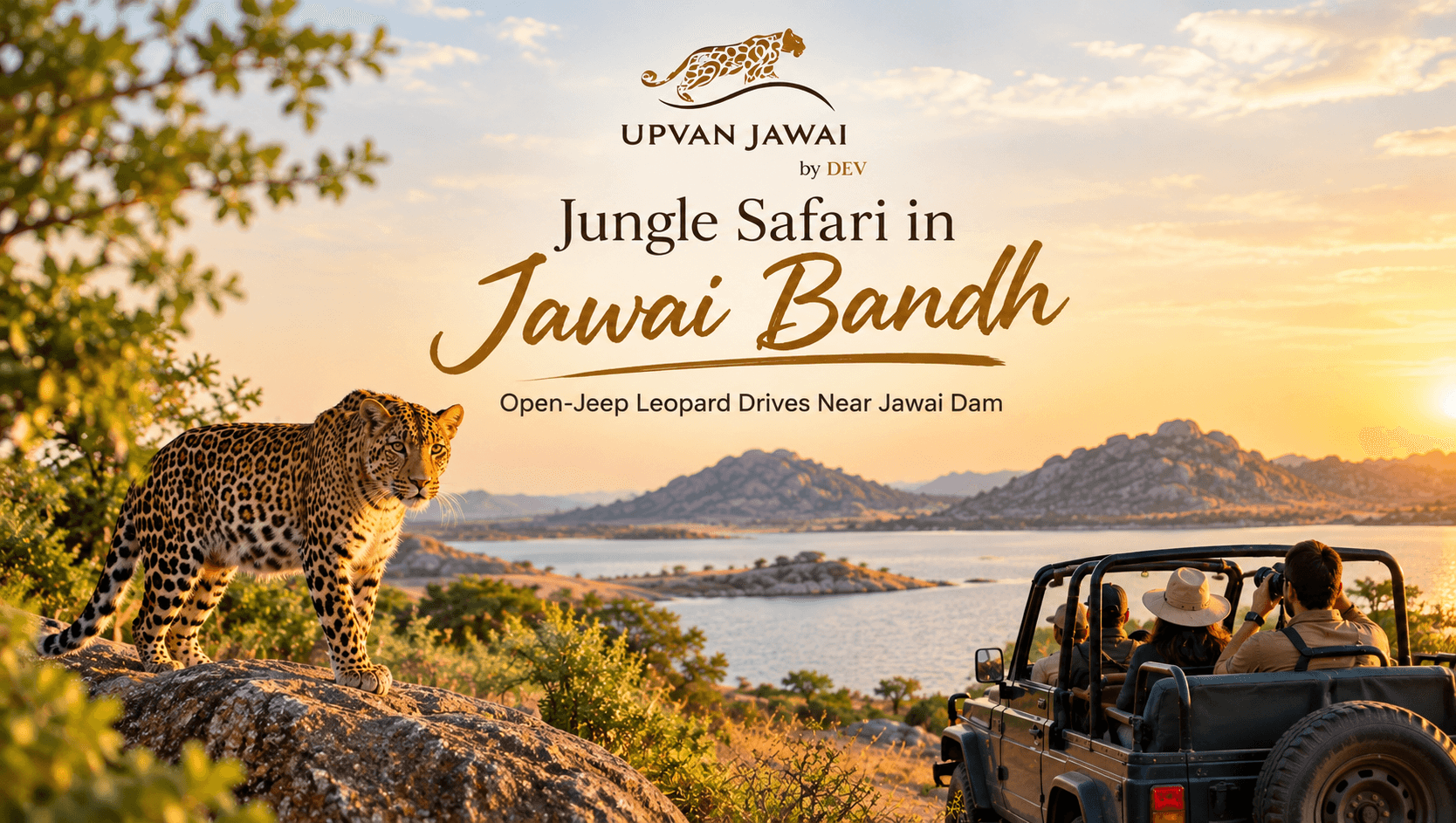
If you're searching for a jungle safari in Jawai Bandh, you're looking at one of the most unusual wildlife experiences in India — a place where leopards live in open granite hills beside working villages, with no fences, no park gate, and some of the highest leopard density anywhere in the country. This guide covers everything you need to know before booking: what a Jawai Bandh jungle safari actually involves, when to go, and how to give yourself the best chance of a sighting.
What Is a Jungle Safari in Jawai Bandh?
A jungle safari in Jawai Bandh is a guided open-jeep drive through the granite hills, caves, and scrub surrounding the Jawai Dam reservoir in Pali district, Rajasthan. Unlike India's tiger-reserve safaris, this isn't a fenced or gated circuit — most of the safari ground lies outside the small notified reserve, on community land shared with local herding families.
Quick facts:
- Location: Jawai Bandh (Jawai Dam), Pali district, Rajasthan
- Terrain: Granite outcrops, caves, thorn scrub, farmland, reservoir edge
- Vehicle: Open 4x4 jeep with a resident naturalist
- Drive slots: Dawn and dusk, timed to sunrise/sunset
- Permit needed: No Forest Department permit for most safari ground
- Reserve: Jawai Bandh Leopard Conservation Reserve, notified 2010, 19.79 sq km
- Season: Open year-round, no seasonal closure
With Upvan Jawai, drives leave directly from the property, so a dawn jungle safari in Jawai Bandh doesn't start with a long transfer — you're in the hills within minutes.
How Much Does a Jawai Leopard Safari Cost?
Every safari experience at Upvan Jawai is ₹5,500 per Gypsy, with a maximum of six guests per vehicle. The price is the same whether two or six of you ride, so a full Gypsy works out to under ₹1,000 per person.
Safari Experience Focus Price Per Gypsy (Max 6)
Jungle and Leopard Safari
Andheri jungle, leopard sites and local stories
₹5,500
Temple and Village Safari
Pandav temples, Rabari homes, heritage high tea at the dam
₹5,500
Maad Jungle and Kambeshwar Ji Temple Safari
Sloth bears, deer, mongoose, reptiles and a hilltop temple
₹5,500
Sundowner High Tea or Breakfast at the Dam
Candlelit setup on Jawai Dam
₹5,500
Request Rates for Your Dates → Why Jawai Bandh Is Different From Every Other Jungle Safari in India
Most Indian safaris happen inside gated national parks with fixed permit quotas and a monsoon closure. Jawai breaks that model.
- No fences, no gate. Leopards here move freely across granite hills that border village land, so a jungle safari in Jawai Bandh feels less like a controlled circuit and more like tracking real, unbothered wildlife in its own territory.
- Exceptional density, exceptional visibility. Jawai has one of the highest leopard densities recorded in India. Because the terrain is open rock rather than dense forest, leopards here are unusually easy to spot — often resting in daylight on exposed boulders, something that's rare almost anywhere else in the country.
- No seasonal closure. Because most of the safari ground sits outside the notified reserve, drives run 12 months a year.
- A working ecosystem, not a reserve. Jawai Dam — built in 1956–57 and the largest reservoir in western Rajasthan — sustains the whole system. It concentrates prey through the dry months, draws 200+ recorded bird species including greater flamingos, and supports a resident population of mugger crocodiles. The granite caves above the waterline give leopards secure daybeds within sight of the villages below.
What Happens on a Jungle Safari Drive in Jawai Bandh
A morning drive leaves before first light. Layer up — an open jeep off the reservoir is genuinely cold from November through February, though you'll likely shed the jacket by mid-morning.
The jeep climbs into boulder country, where wind and rain have carved the granite into rounded stacks and low caves. Then, often, everything stops: engine off, naturalist listening.
Tracking on granite isn't about pug marks — the rock barely holds a print. Instead, guides read the hills through:
- Alarm calls — peafowl and langur usually announce a leopard before anyone sees it
- Cave use — knowing which daybed a resident female favours that month
- Territory patterns — which slope a male has been crossing at dusk
- Herd movement — watching where local Rabari flocks are grazing, and where they're avoiding
First-time guests often expect continuous motion. What they get instead is long, quiet stretches followed by a sudden, sharp moment when a shape on a distant rock resolves into a leopard. Most people say that rhythm — not the sighting itself — is what they remember.
What's Included in a Jawai Bandh Jungle Safari
Typically included: open 4x4 jeep and driver, resident naturalist guide, community access permissions.
Typically not included: station/airport transfers, filming fees, gratuities.
(Confirm exact inclusions with the property before publishing.)
Best Time for a Jungle Safari in Jawai Bandh
PeakOct–MarMild days, cold dawns, migratory birds on the reservoir. Books out first.SummerApr–Jun40°C+. Shrinking water concentrates wildlife — strong for photographers.MonsoonJul–SepGranite turns green. Fewest visitors, lowest rates. Some tracks difficult.
October to March is the most comfortable window and the one most first-time visitors choose. Because there's no closure, Jawai remains one of the few Indian safari destinations you can genuinely visit in any month.
Seasonal drive timings (standard Jawai market slots — confirm exact Upvan Jawai times):
Winter6:00–9:00 AM4:00–7:00 PMSummer5:00–8:00 AM5:00–8:00 PM
How Likely Are You to See a Leopard?
Sightings are frequent, and many guests spot a leopard on their first drive. But these are wild, unbaited, unfenced animals — no responsible operator will promise a guaranteed sighting or publish a sighting-rate percentage. Be cautious of any Jawai operator that advertises a number like "95% sighting rate."
What actually improves your odds:
- Book at least three drives — practically, a minimum two-night stay
- Visit October–March
- Take both slots, dawn and dusk
- Stay at a sighting rather than moving on early
- Let the naturalist lead — this is their landscape
Responsible field conduct on every drive:
- Distance is held; the leopard decides how close an encounter gets
- Guide-led routes only, no off-track pursuit
- No baiting, calling, or crowding
- Engine off, voices down at a sighting
The Rabari: Why This Jungle Safari Exists at All
Jawai's leopard population survives beside people because of the Rabari, herding families who have grazed sheep and goats across these hills for generations without a tradition of retaliating against leopards. There are no fences separating livestock from wild cats here — coexistence is a choice this community has sustained, not a natural accident.
Every jungle safari in Jawai Bandh depends on that arrangement, which is worth remembering when a jeep idles fifty metres from someone's home at dawn.
Is a Jungle Safari in Jawai Bandh Safe for Children?
Generally yes. Jawai is one of the few places in India where leopards and people coexist at this density without a history of conflict, and every drive is conducted from inside the vehicle under naturalist supervision.
The real limiting factor is attention span, not danger — a three-hour dawn drive with long silent waits can be a lot to ask of a young child. Birding at the reservoir and village walks tend to suit families with younger kids better than a full safari drive. (Confirm minimum jeep age and whether shorter drives can be arranged.)
What to Pack for a Jawai Bandh Jungle Safari
- Neutral colours — olive, khaki, beige
- Closed shoes
- Jacket, scarf, and hat for dawn drives (Nov–Feb)
- Binoculars — most sightings start as a distant shape on rock
- A 200–500mm lens if shooting photography
- No perfume or strong scents
How to Book a Jungle Safari in Jawai Bandh with Upvan Jawai
- Send your travel dates via the enquiry form or WhatsApp: +91 90798 46869
- Choose your drives — morning, evening, both, or full-day
- Confirm — slots are held against your booking, not allocated on arrival
- Arrive — the jeep leaves directly from the property
Jeep numbers across Jawai are limited, and October–March weekend slots typically sell out before rooms do.
FAQ: Jungle Safari in Jawai Bandh
Are leopard sightings guaranteed?
No. Sightings are frequent but never guaranteed on wild, unfenced ground. Treat any operator's published "sighting rate" with caution.
How many drives should I book?
Three drives is the practical minimum for a strong chance of a sighting, which means planning at least a two-night stay.
Do I need a permit for a Jawai Bandh jungle safari?
No Forest Department permit is required for most safari ground, since it sits outside the notified conservation reserve on community land.
What's the difference between Jawai Bandh and Jawai Dam?
None — they're the same place. "Bandh" means dam in Hindi.
When is the best time to book a Jawai jungle safari?
As early as possible for October–March, especially weekends and year-end holidays. Summer and monsoon can be booked at shorter notice.
Written by Upvan Jawai
Plan your stay